Best Mobile Detailing Supplies 2026: What I Actually Buy
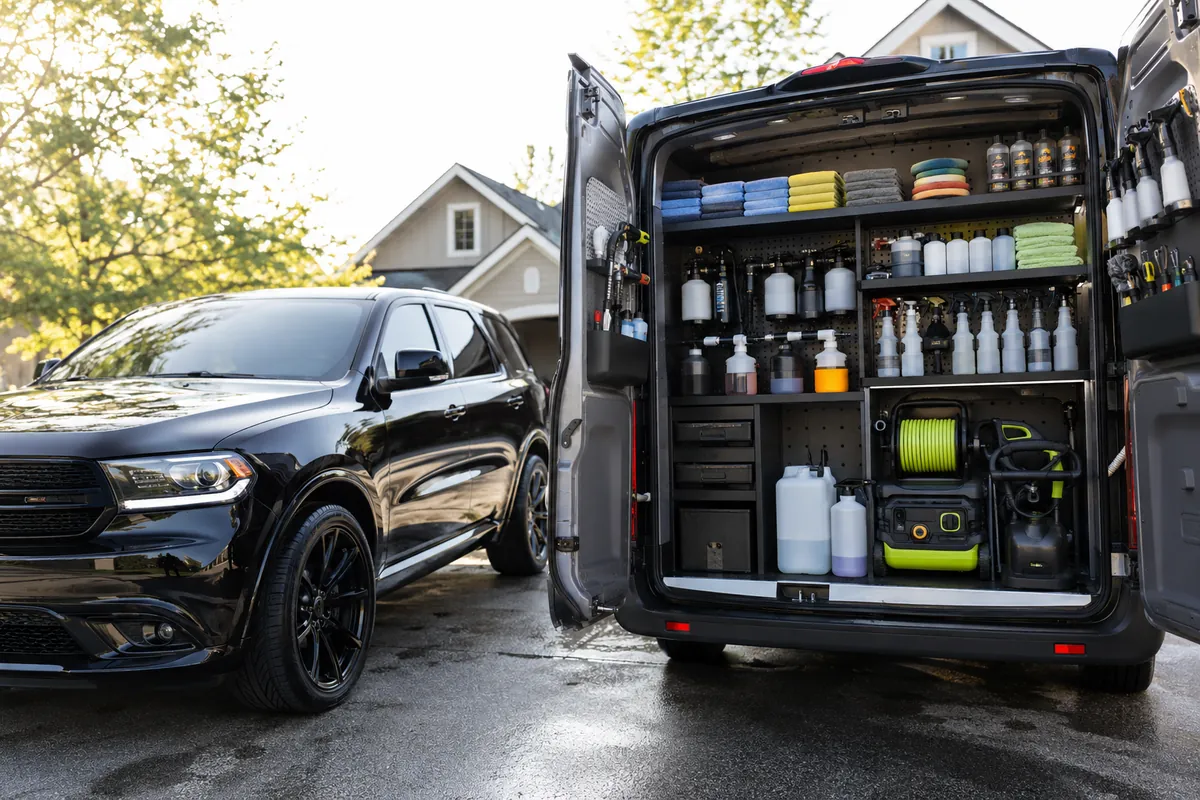
Best mobile detailing supplies: after nine years and two vans' worth of trial and error, this is the gear that earns its keep on every job and the gear I wish someone had told me to skip.
I started detailing out of my apartment parking lot in Tampa with a pressure washer, a shop vac, and a bucket of whatever was on sale at the auto parts store. Nine years later I run two vans and I've bought, broken, returned, and replaced more detailing gear than I care to admit. This list isn't sponsored wishful thinking. It's what's actually riding in my vans right now, plus the stuff I tried and quietly dumped.
If you're researching prices for your own market while you shop, my mobile detailing prices breakdown pairs well with this article. And if you're building the truck itself, read my van setup guide next, because the gear below has to live somewhere.
How I Buy: Cost Per Job, Not Sticker Price
The number on the shelf tag means almost nothing to me. What matters is cost per job. A $30 wash mitt that lasts 200 jobs costs 15 cents a job. A $8 mitt that scratches a customer's black Tahoe costs me a paint correction and maybe a review. That math has burned itself into how I shop.
Here's my actual rule set:
- Consumables get bought in bulk once I've tested a small size. Soap, APC, towels.
- Anything with a motor gets bought once, bought right. Vacs, extractors, polishers. Cheap motors die mid-job, and a dead motor on a mobile job means refunding a customer in their driveway.
- Anything that touches paint gets zero compromise. Mitts, towels, pads.
- Gimmicks get ignored until a detailer I actually know has run one for six months.
That framework will save you more money than any product recommendation in this article. But here are the recommendations anyway.
The Wash Bay on Wheels
Soap
I've run Chemical Guys Mr. Pink as my daily driver soap for about five years. It's not exotic, it's just consistent: good slickness, rinses clean, doesn't strip sealants, and a gallon dilutes far enough that my cost per wash is pocket change. For trucks coming off a job site caked in Florida love bugs and clay dust, I step up to a stronger pre-wash with P&S Brake Buster on wheels and lower panels. Brake Buster is technically a wheel cleaner but it's the hardest working bottle in my van.
Mitts and Towels
Two mitts minimum per job: one for the top half, one for the bottom half of the car. I use Meguiar's microfiber wash mitts because they're cheap enough to retire without guilt and soft enough that I've never traced a scratch back to one.
Towels are where new detailers bleed money in both directions. Don't buy gas station towels, and don't buy $12-a-piece boutique towels for door jambs. I run a three-tier system: plush microfiber drying towels for paint, mid-grade all-purpose microfibers for interiors, and a stack of dead towels demoted to wheels and exhaust tips. Buy them in bulk packs, wash them separately from anything cotton, and never use fabric softener. That last one isn't a suggestion.
Pressure Washer
You do not need a commercial hot water rig to start. My first machine was a little electric unit and honestly an electric is still right for most mobile washes. A Ryobi electric pressure washer in the 1,800 to 2,000 PSI range does everything a wash needs, sips water from your tank, and won't tear up trim if a new hire grabs it. I keep a standard foam cannon on a quick connect, nothing fancy. Foam isn't magic, but it buys you lubrication and it looks professional in the customer's driveway, which matters more than people admit.
The Interior Arsenal
Interiors are where mobile money is made in my market. Exterior washes are a commodity. A genuinely clean interior gets you the repeat customer.
Vacuum
Buy a Metro Vac or an equivalent small commercial vac and stop thinking about it. I ran consumer shop vacs my first two years and they all died the same death: clogged filters, fading suction, and one memorable smoke event in a customer's garage. The little Metro units also double as blowers for cracks, cupholders, and drying emblems, which saves real minutes on every job.
Extractor
This is the first "real" purchase that separates hobbyists from operators. An extractor pulls shampoo and dirt back out of carpet and cloth seats instead of leaving them soggy. I started with a Bissell spot cleaner, which is fine for year one, then moved to a Mytee extractor with heat. The Mytee was around ten times the price and it was still worth it: faster dry times, deeper pulls, and it lets me confidently book two interiors back to back. If your budget says Bissell, buy the Bissell and upgrade when interior bookings justify it. That's exactly what I did.
Chemicals and Brushes
One good all-purpose cleaner, diluted three different ways, replaces a shelf of specialty bottles. I run an APC at strong dilution for door jambs and floor mats, medium for plastics, weak for headliners. Pair it with a detailing brush set for vents and seams and a stiffer carpet brush for mats. For dressing, 303 Aerospace Protectant is my interior finisher because it leaves a factory satin look instead of a greasy shine. Customers in 2026 do not want shiny dashboards. They want clean ones.
Paint Correction Starter Kit
Don't buy a rotary. Don't buy a $79 polisher kit with foam pads the texture of pancakes. Here's the sane middle.
A dual action polisher is safe enough to learn on and capable enough to never outgrow for mobile work. The Griot's Garage DA polisher is what I trained both of my guys on, and the lifetime support reputation is real. If you've got more budget and want lighter weight for all-day correction, Rupes polishers are the step up, though for one-step polish jobs in a driveway the Griot's does everything I bill for.
Pads: a half dozen foam pads in two cuts, that's it to start. Compound and polish: Meguiar's Ultimate Compound and a finishing polish cover 90 percent of the swirled daily drivers you'll actually see. The exotic compound lineup can wait until somebody pays you for a multi-step.
Protection: Where the Margin Lives
Every wash should end with protection, because protection is an easy upsell with honest value. My default is a spray sealant applied during the dry: fast, durable for a few months, and it makes the next wash easier. Adam's Graphene Ceramic Spray type products are the current sweet spot, and CarPro Reload has been a reliable standby in my van for years.
Full ceramic coatings are a different business with different prep requirements and different liability. I offer ceramic-lite spray packages to wash customers and refer true multi-year coatings carefully. Know which business you're in before you promise a customer five years of protection off a $25 bottle.
The Do-Not-Buy List
Money I've wasted so you don't have to:
- Waterless wash as a primary method. Fine for a show car in a garage. On a Florida work truck it's a scratch delivery system.
- Cheap cordless "detailing" vacs. The suction reads fine in reviews and dies in cupholder number three.
- Steam machines under a few hundred dollars. The consumer units make hot mist, not steam. A proper steamer is great, a toy steamer is a delay with a power cord.
- Branded "kits" with 14 bottles. You're paying for six products you need and eight you'll never finish.
- Scent bombs and miracle odor sprays. Odor lives in the headliner and carpet pad. Extraction and ozone fix odor. Perfume hides it for a week and then your phone rings.
One supply most lists ignore: a way to control where your wash water goes. Mobile work means you're rinsing soap and road grime in someone's driveway, and that runoff is regulated as a pollutant under the EPA's stormwater discharge program. A few dollars of berm or a drain mat keeps wash water out of the storm drain, and out of a code officer's report.
Budget Table: Starter Kit vs Full Mobile Rig
These are rough numbers from my market and my receipts, hedged accordingly. Your local pricing will wiggle.
| Category | Starter (~$600) | Full Mobile Rig (~$3,500) |
|---|---|---|
| Wash chemicals and soap | $60 | $150 (bulk gallons) |
| Mitts and towels | $80 | $200 (tiered system, 60+ towels) |
| Pressure washer and foam | $130 (electric) | $350 (electric plus backup) |
| Vacuum | $90 (shop vac) | $250 (Metro class) |
| Extractor | $0 (skip year one) or $130 Bissell | $900 (Mytee class, heated) |
| APC, brushes, interior | $70 | $200 |
| Polisher, pads, compound | $0 (skip year one) | $700 (Griot's DA setup) |
| Protection products | $40 | $250 (sealants, ceramic-lite) |
| Misc (buckets, bottles, organizers) | $70 | $500 |
The starter column got me through my first year in that apartment parking lot. The full rig column is roughly what's in each of my vans today, not counting the van itself, the water tank, or the generator. Those big-ticket pieces have their own article: my full van setup breakdown.
Frequently Asked Questions
What supplies do you actually need to start mobile detailing?
At the bare minimum you need a soap, two wash mitts, a tiered set of microfiber towels, an electric pressure washer, a vacuum, one good all-purpose cleaner, and a basic protection spray. That's a real working kit for wash-and-vac jobs plus light interiors. Everything else, including the extractor and the polisher, is an upgrade you buy once interior and correction bookings justify it, not a day-one purchase.
How much does it cost to buy mobile detailing supplies?
A genuine starter kit runs around $600 if you skip the extractor and polisher your first year, which is exactly how I started. A fully stocked mobile rig lands closer to $3,500 once you add a heated extractor, a DA polisher, bulk chemicals, and a tiered towel system. The trick is to buy consumables in bulk only after you've tested a small size, and to buy anything with a motor once and buy it right.
Is an extractor worth it for mobile detailing?
Yes, once interiors are paying the bills. An extractor pulls shampoo and dirt back out of carpet and seats instead of leaving them soggy, which is the actual difference between a seat that's clean and one that smells like a gym bag a week later. Start with an affordable spot cleaner in year one, then move up to a heated extractor when back-to-back interior bookings make the faster dry times pay for themselves.
What detailing supplies are a waste of money?
Waterless wash as a primary method, cheap cordless "detailing" vacs, sub-$200 steam machines, 14-bottle branded kits, and miracle odor sprays. Every one of those either underperforms, dies fast, or hides a problem instead of fixing it. One good all-purpose cleaner diluted three ways replaces most of a specialty-bottle shelf.
What soap should I use for mobile car washing?
A consistent pH-neutral car wash soap that rinses clean and doesn't strip sealants is all you need for daily work. I've run the same mid-priced soap for years because slickness and clean rinsing matter far more than an exotic label. Step up to a stronger pre-wash only for trucks coming off a job site caked in real grime.
Do I need to worry about wash water when detailing in a driveway?
Yes. Soapy runoff carries oil, brake dust, and chemicals, and under the EPA's stormwater rules that discharge into a storm drain can be a violation in many municipalities. A cheap berm, drain mat, or reclamation setup keeps wash water out of the storm system, and California and a growing list of cities enforce this seriously.
Buy Gear, Then Get Booked
Supplies don't make money sitting in totes. If you're starting out, my guide on how to start a mobile detailing business covers the licensing and booking side. If you're already operating, get your detailing business listed so customers in your area can actually find you. And if you're a car owner who read this far and decided you'd rather pay a pro, smart move: find a mobile detailer near you and ask them what's in their van. If they can answer the way I just did, hire them.